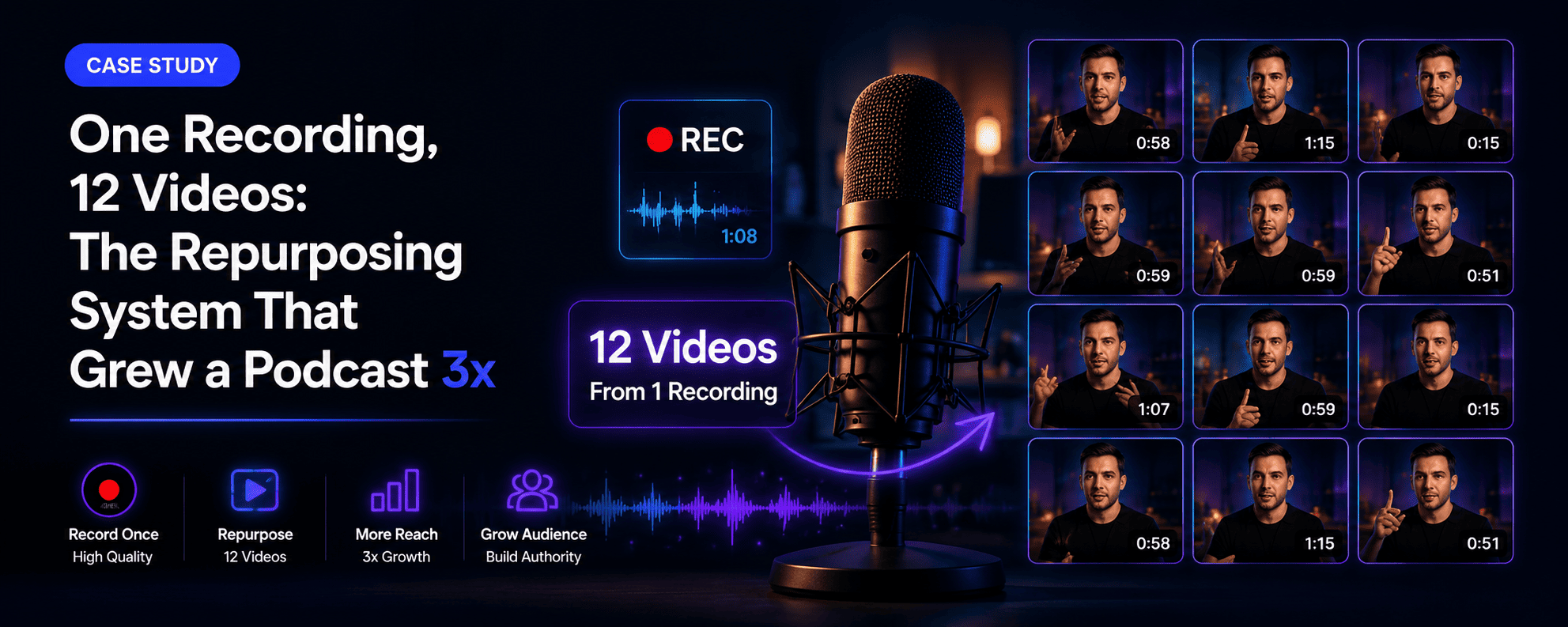
A B2B podcast host came to us exhausted. They were recording a two-hour weekly conversation, and getting maybe 20% of it published as a raw YouTube video plus one or two short clips. The archive was growing faster than the channel.
The fix wasn't a bigger camera budget. It was a repurposing system that treats one recording as a raw material vault instead of a single deliverable.
The system
- 1Full long-form cut: the core conversation, tightened to its sharpest 45–55 minutes, with chapters and an intro that names the specific guest and topic.
- 2Highlight long-form: a 12–18 minute 'best of' built around the single most valuable idea in the episode.
- 310 vertical clips: each one a self-contained idea with its own hook, caption, and CTA back to the full episode.
- 4Short-form thumbnails and captions: every clip optimized for silent watching and search.
The key decision was that clips would not be random moments. Each clip was chosen because it works as a standalone search result — a concrete question, answered clearly, in under 60 seconds.
What moved
- Channel reach grew ~3x over five months as the clips began surfacing in search and Shorts.
- The 'best of' videos consistently outperformed the full episodes on first-timer channels.
- Each full episode now feeds discovery for a week, not a day — the clips are entry points, and the long-form does the converting.
- The host's recording workload stayed exactly the same: one two-hour session per week.
Repurposing is not recycling. A clip that just re-crops a moment brings nothing new to the algorithm. A clip built as its own search result — with its own hook and payoff — is a new piece of content, and it ranks like one.
The lesson we keep repeating to clients: the most expensive asset in your business is a recording that produces one video. The same session should be feeding long-form, shorts, podcast feeds, and search for weeks.