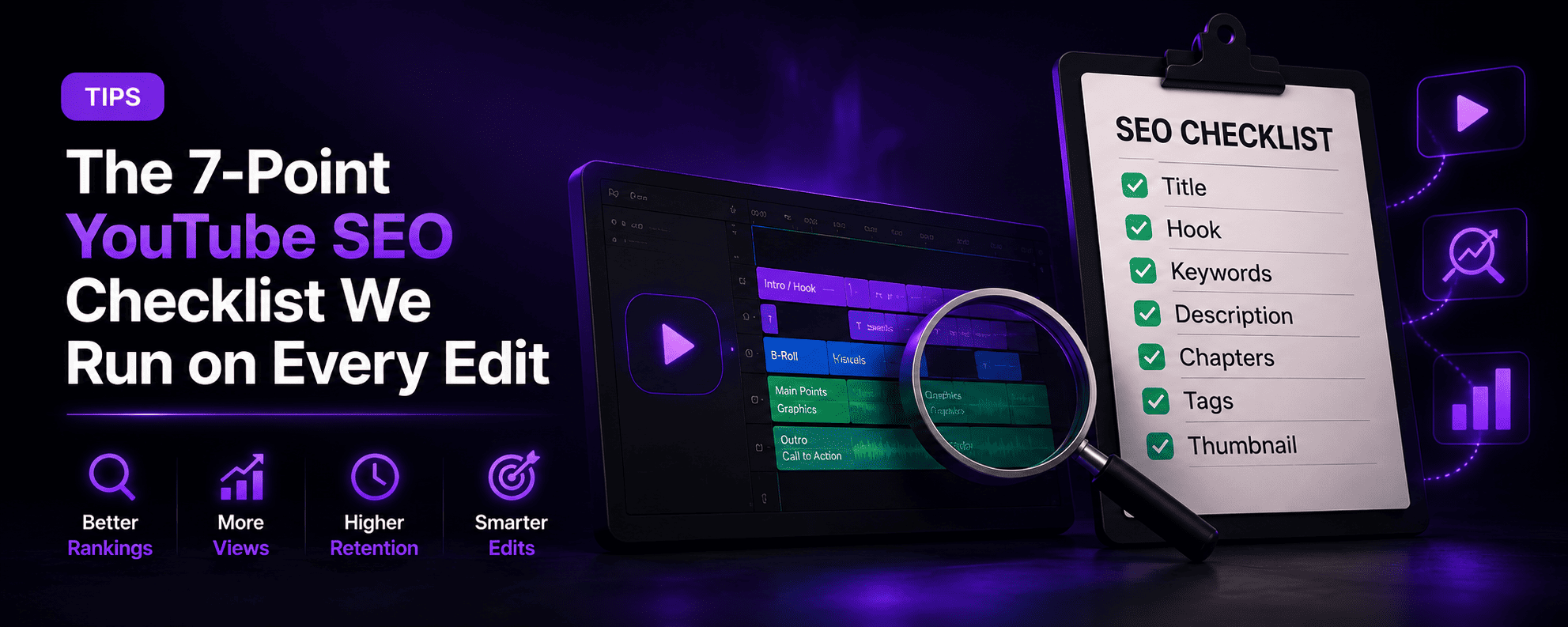
Most people treat YouTube SEO as a post-production chore: title, description, tags, done. By then, most of the ranking decisions have already been made inside the edit. Here's the checklist we run on every single video before it leaves the timeline.
1. The first 15 seconds are a search result
If your title is 'How to fix your cash flow in 2026', the first 15 seconds need to name that problem out loud. Not in passing — explicitly. YouTube matches the spoken words in your video against the search query. Say the keyword, in a natural sentence, in the first 30 seconds.
2. One search intent per video
A video that answers one clear question ranks. A video that meanders through three topics ranks for none of them. If your script covers multiple questions, that's a signal the edit should split it or sharpen the focus.
3. Chapters are metadata, not decoration
Chapters do three SEO jobs at once: they surface in search results as extra links, they help Google understand structure, and they improve average view duration by letting viewers jump to exactly what they came for. Write them like search snippets, not 'Part 1' / 'Part 2'.
4. On-screen text matches the search phrase
Pull quotes, lower-thirds, and title cards get read by YouTube's speech recognition just like the audio. When the search phrase appears on screen, you reinforce the relevance signal. Use the exact phrase, verbatim, at least once.
5. The spoken intro should match the title exactly
The strongest relevance signal you control is a spoken line that matches your title and first-line description almost word-for-word. It's not about stuffing; it's about making the relevance unambiguous to both YouTube and the viewer who clicked.
6. Retention beats everything
Keywords get you considered. Retention gets you ranked. Two videos targeting the same query will always resolve in favor of the one people finish. We review every edit against the retention curve before it exports — no exceptions.
7. Description and tags are written from the timeline
We draft the description from what actually happens in the video, not from a keyword list. Timestamps from the real cut, the real phrases used on camera, the real outcome promised. This keeps description and content aligned, which is what YouTube's systems reward.
If SEO is only a title-and-tags conversation, the edit is where it's being lost. Run these seven checks while you still have the ability to change the video — that's when they actually matter.